28 November 2025
Meet the team: Qiaogang (Toni) Wei, Simplified Chinese translator
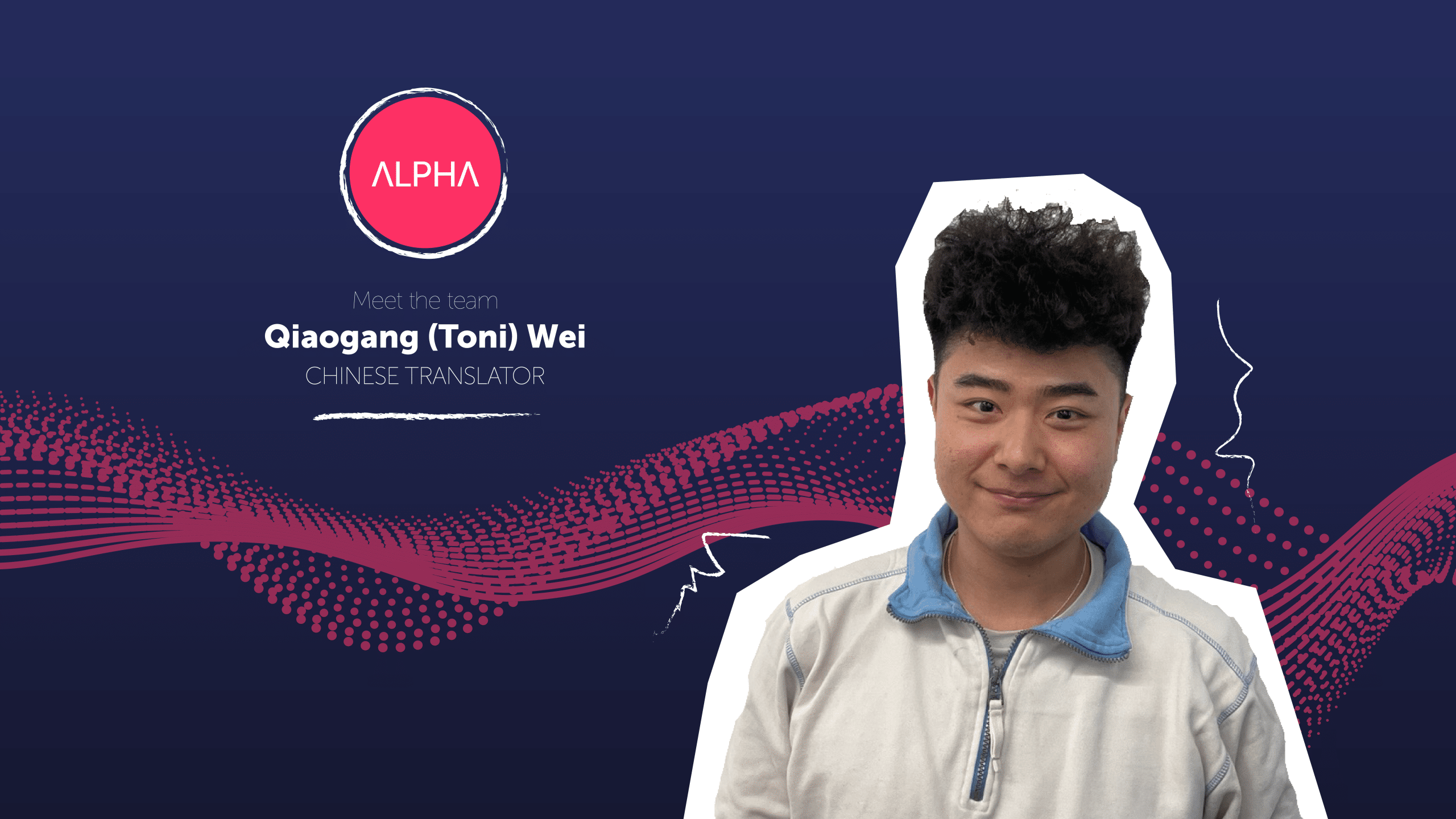
Next up in our Meet the Team series is Qiaogang Wei, a Simplified Chinese Translator at Alpha CRC.
Hi Qiaogang, in your dual role, we know you’re a busy person, so thanks for taking time out to talk with us. First off, can we ask how long you’ve worked in localization and what your typical workday looks like?
Hi, of course. My role is a fusion of client strategy and creative execution. I translate business objectives into localized reality. One hour I’m optimizing a budget for global rollout; the next, I’m hands-on with translations, ensuring the brand voice is perfectly adapted. It’s this dual perspective that allows me to guarantee both linguistic quality and commercial success for our partners.
What do you enjoy most about your role at Alpha CRC?
I love the creative aspect of it, taking a brand’s voice and amplifying it for different markets. It’s rewarding to shape how a brand communicates across cultures. Seeing a campaign we’ve adapted perform exceptionally well is the ultimate reward.
Can you tell us a little about how you got started in translation/localization?
My journey began at the intersection of media and culture, working as an interpreter and subtitler for international celebrity interviews. This gave me a front-row seat to the power of cultural adaptation and how to capture an audience’s heart. It was the perfect foundation for moving into strategic localization, where we do the same for global brands.
In the course of your role, what kind of tasks do you enjoy most?
I’m particularly passionate about video localization. In today’s attention economy, a 15s video can achieve what 1000 words cannot. It’s the ultimate format for creative transcreation, allowing us to craft emotionally resonant stories that achieve massive reach. From a business perspective, it’s also incredibly powerful. The performance metrics are clear and tangible, providing clients with undeniable proof of ROI on their localization spend.
As a linguist, which aspects of your work have you been most proud of?
We partner with a quintessentially British brand whose identity is built on a unique, poetic flair. A direct translation would have completely diluted their voice. We were trusted to go off-script sometimes and draft a truly localized poem for a campaign. The result was a significant spike in positive social engagement and brand interaction, proving that when you translate a feeling, not just words, the commercial results follow.
If you could give one piece of advice to someone starting in this field, what would it be?
Stay open-minded and proactively incorporate AI into your workflow. But never outsource your strategic thinking. The future of localization lies in professionals who can use tools to elevate their work, preserving the crucial human elements of cultural nuance, creativity, and brand empathy that truly move audiences.
If you could instantly become fluent in any language, which would you choose and why?
I’d choose Spanish. I’ve always liked the Spanish word ‘¿Que?’. For just one syllable, it conveys so much – curiosity, surprise, even confusion. It’s incredibly versatile for a single word.
I’m currently obsessed with Rosalía’s new album, and I’ve always felt it’s a beautiful and passionate language, while also opening doors to vibrant and growing markets. It would be amazing to be fluent. As a bonus, it would probably give me a head start on understanding a bit of Italian and Portuguese too!